How to Track Calories Without a Food Scale
By Theo Marchetti · Published October 22, 2026 · Updated October 22, 2026
You do not need a kitchen scale to track calories usefully. Your hand, a few household objects and a phone camera get most people within a sensible margin, and a scale is only worth using for a week to calibrate your eye.
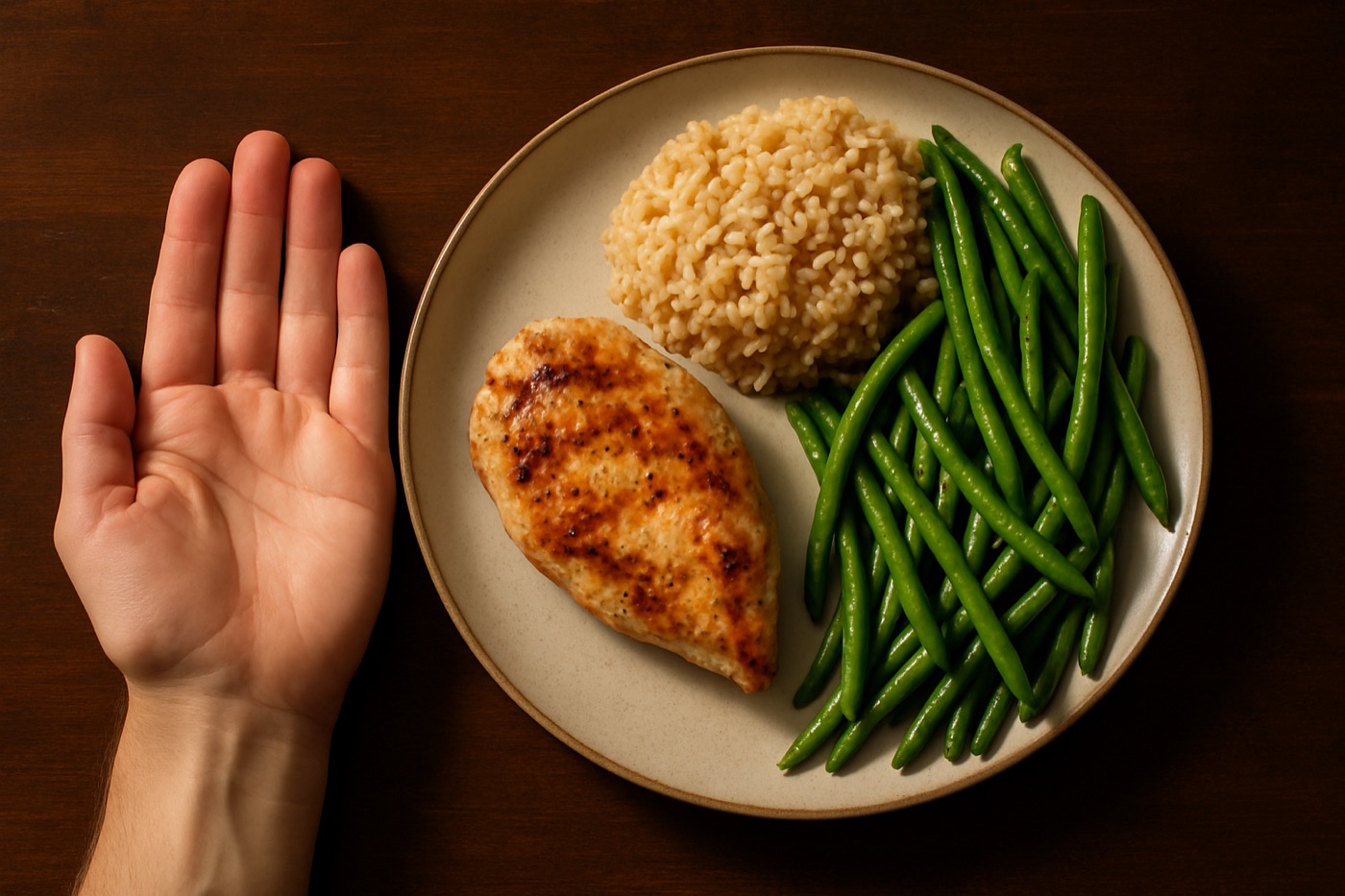
Weighing every meal is the most precise way to count calories, and almost nobody keeps it up. The good news is that you do not need to. What matters for most goals is a consistent, reasonable estimate, logged every day.
The hand method
Hands scale with body size, so they make a surprisingly practical portion guide:
| Food | Hand guide | Roughly |
|---|---|---|
| Meat, fish, tofu | Your palm (thickness and size) | 3–4 oz cooked |
| Vegetables | Your fist | About 1 cup |
| Rice, pasta, potatoes, cereal | A cupped hand | About ½ cup |
| Oil, butter, nut butter | Your thumb | About 1 tablespoon |
Household comparisons
- A deck of cards: about 3 oz (85 g) of cooked meat
- A tennis ball: about ½ cup of rice or pasta
- A baseball: about 1 cup
- Two dice: about 1 oz of cheese
- The tip of your thumb: about 1 teaspoon
Where estimates go wrong
Portion guesses are not equally risky. Research on portion estimation has repeatedly found that errors tend to grow with portion size, and with dense foods a small error is a large number of calories. A practical ranking:
| Food | Risk of a big miss | Why |
|---|---|---|
| Oils and butter | Very high | Invisible once cooked; one extra tablespoon is 100–120 calories |
| Nut butters and nuts | Very high | A “spoonful” can be 1 or 3 tablespoons |
| Cereal and granola | High | Bowls are often twice the label serving |
| Cheese | High | Grated cheese is hard to judge |
| Rice and pasta | Medium | Restaurant and home portions vary widely |
| Meat and fish | Medium | Palm sizes vary; thickness matters |
| Fruit | Low | Usually counted by the piece |
| Vegetables | Very low | Even a large error is a small number |
If you only calibrate a few foods, calibrate the top of this table.
Logging by the piece
Many foods come in natural units that are easier than weight: one medium banana, two eggs, one slice of bread, one apple, one tortilla, one pot of yogurt. Database entries for “medium” items are usually reasonable. If your apples or bananas are large, choose the large entry.
Measuring cups and spoons
For foods you eat often, such as cereal, oats, rice and peanut butter, measure once with cups and spoons. Pour your usual amount, then measure it. Most people are surprised the first time, especially with cereal and nut butter.
Calibrate once with a scale (optional)
If you can borrow a scale, use it for one week on your regular foods. You will learn what 100 g of rice or chicken looks like on your plates, and your estimates afterwards will be much better. Then put the scale away.
A plate method for mixed meals
When the meal is a plate rather than a list of ingredients, divide it in your head:
- Half the plate vegetables: log as one or two cups.
- A quarter protein: about one palm.
- A quarter starch: about one cupped hand to one fist.
- Plus the fat: a thumb of oil, butter or dressing for anything cooked or dressed.
This plate is also a reasonable default for a calorie deficit; it tends to land between 450 and 650 calories depending on the foods.
Eating at someone else’s table
At a friend’s home or a family dinner, use the hand method silently and add a thumb of fat for anything roasted or sautéed. Nobody needs to know you are counting, and an estimate keeps your log intact.
Use the camera
Photo logging is the modern alternative to a scale for mixed plates. A good AI tracker estimates the portions from the picture and lets you adjust them; apps that ask you to confirm when they are unsure avoid confident mistakes.
Check yourself against the scale you do have
Your bathroom scale is the final judge. If you estimate consistently and your weight trend over three or four weeks matches what your log predicts, your estimates are good enough. If not, adjust portions or your target slightly and keep going.
The bottom line
Hands, cups and the occasional photo are enough for most people. Spend your effort on the dense foods where small errors are large, ignore the vegetables, and let your weight trend over a few weeks tell you whether your estimates are close.
Related guides: Calorie density · Log a home-cooked recipe · Track calories at restaurants
Questions readers ask
How can I measure food portions without a scale?
Use your hand as a guide (a palm for protein, a fist for vegetables, a cupped hand for carbs, a thumb for fats), measuring cups and spoons, or common objects such as a deck of cards for about 3 oz of meat.
Is counting calories without a scale accurate enough?
For most people, yes. Consistency matters more than precision: estimating the same way every day still shows you the trend, and your weight over a few weeks tells you whether your estimates are close.
How many calories are in a handful of nuts?
A small handful, about 1 oz or 28 g, is roughly 160 to 200 calories depending on the nut. Because nuts are dense, a generous handful can easily be double that, which is why they are worth measuring with a spoon or a small cup a few times.
What foods are most worth measuring?
The calorie-dense ones, where a small error is a big number. Oils, butter, nut butters, nuts, cheese, granola, cereal, rice and pasta are worth measuring at least once. Vegetables and most fruit are not worth measuring at all.
More: Guides · Reviews · Comparisons · The 2027 ranking