Calorie Density – How to Eat More Food for Fewer Calories
By Hannah Whitlock · Published October 22, 2026 · Updated October 22, 2026
Calorie density is the number of calories in a given weight of food. Choosing more low-density foods, such as vegetables, fruit, soups and lean protein, lets you eat satisfying portions while staying within a calorie target.
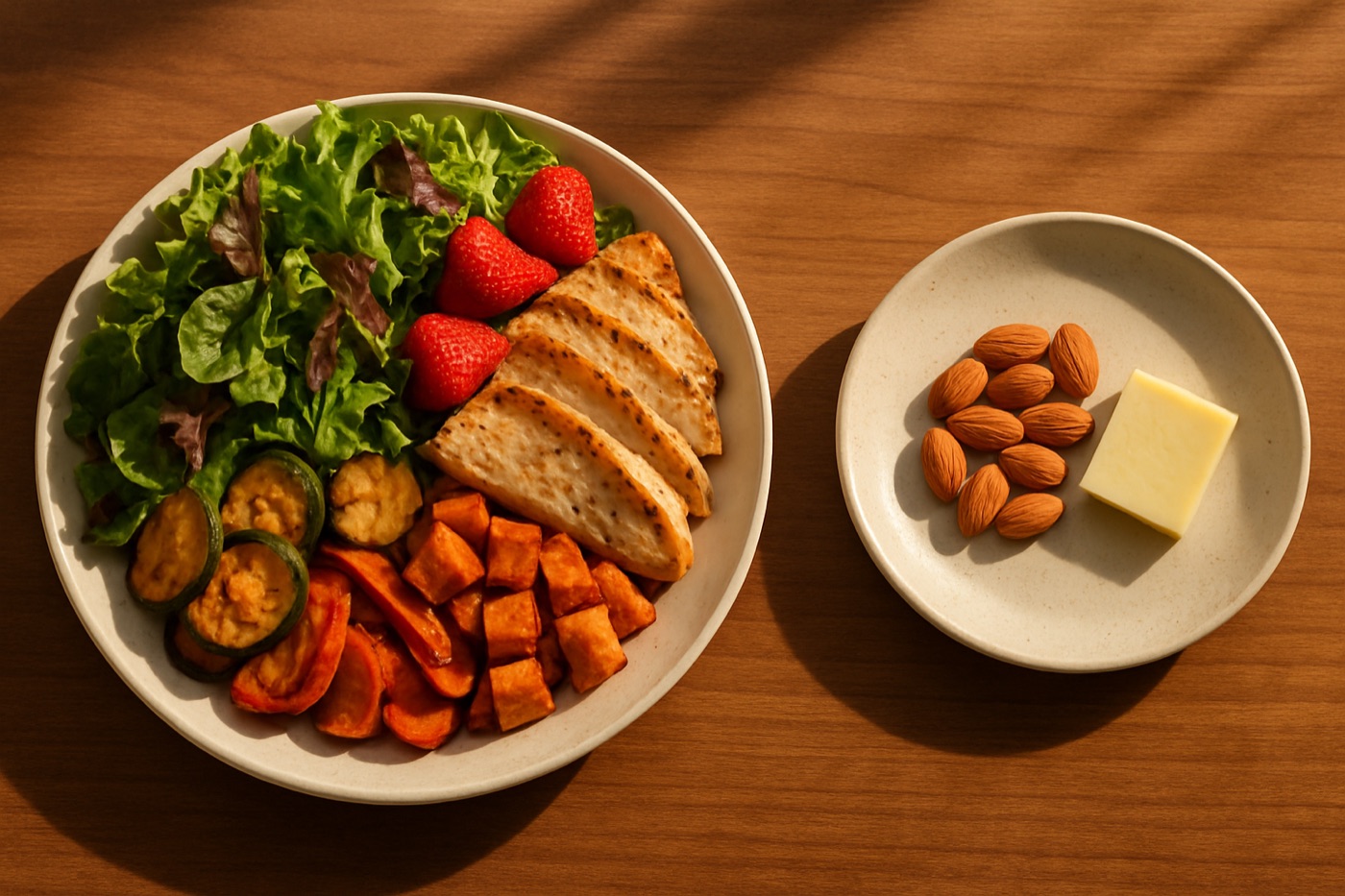
Two plates can hold the same number of calories and look completely different. One is a heaped bowl of salad, chicken, roasted vegetables and fruit; the other is a small handful of nuts and a square of cheese. The difference is calorie density: how much energy is packed into each gram of food.
The numbers
Calorie density is usually expressed in calories per gram (or per 100 grams). Approximate values:
| Food | Calories per 100 g (approx.) |
|---|---|
| Lettuce | 15 |
| Strawberries | 32 |
| Broccoli, cooked | 35 |
| Apple | 52 |
| Potato, boiled | 87 |
| Cooked rice | 130 |
| Chicken breast, cooked | 165 |
| Whole-wheat bread | 250 |
| Cheddar cheese | 400 |
| Almonds | 580 |
| Olive oil | 880 |
The pattern is simple: water and fiber lower calorie density; fat raises it. Fat has about 9 calories per gram, more than twice as much as protein or carbohydrate, and water has none.
Four bands
A practical way to use the idea is to sort foods into rough bands rather than memorizing numbers:
| Band | Calories per gram | Typical foods |
|---|---|---|
| Very low | under 0.6 | Most vegetables, berries, melon, broth soups |
| Low | 0.6–1.5 | Most fruit, cooked oats, potatoes, cooked rice, beans, lentils, lean fish, non-fat yogurt |
| Medium | 1.5–4 | Cooked pasta, chicken, eggs, bread, lean meat, most mixed dishes |
| High | over 4 | Nuts, seeds, oils, butter, chocolate, crisps, most cookies and pastries |
Building meals mostly from the first two bands, with measured amounts from the last, is the whole method in a sentence.
Why it helps with a calorie target
Research on eating behaviour, much of it by nutrition scientist Barbara Rolls and colleagues, has found that people tend to eat a fairly consistent volume of food. When the food is less calorie-dense, they eat fewer calories without feeling they ate less. In practice, that means a calorie target feels much easier when a good share of your plate is low-density food.
Swaps that change the numbers
| Instead of | Try | Approximate saving |
|---|---|---|
| 1 cup granola (about 450 kcal) | ½ cup oats cooked with milk and berries (about 300 kcal) | 150 kcal, and a larger bowl |
| A 60 g bag of crisps (about 320 kcal) | 3 cups air-popped popcorn (about 95 kcal) | 225 kcal |
| 2 cups pasta with cream sauce | 1 cup pasta with tomato sauce and 1 cup roasted vegetables | often 300+ kcal |
| A large glass of orange juice (about 200 kcal) | A whole orange and water (about 60 kcal) | 140 kcal, plus fiber |
| A tablespoon of oil free-poured twice | One measured tablespoon | about 120 kcal |
None of these swaps removes a food group or a meal. They change the proportions on the plate.
Practical ways to use it
- Start meals with a salad or broth-based soup.
- Fill half the plate with vegetables, then add protein and a portion of starch.
- Choose whole fruit over juice and dried fruit.
- Add vegetables to dishes you already like: more peppers in the chili, spinach in the pasta, courgette in the sauce.
- Measure the dense foods. Oils, nut butters, cheese and nuts are healthy but easy to over-pour. A tablespoon of oil is about 120 calories.
A day built on density
Here is roughly what 1,800 calories looks like when most of it comes from the lower bands:
- Breakfast: a large bowl of porridge made with milk, topped with a cup of berries and a spoon of nut butter.
- Lunch: a big bowl of lentil and vegetable soup with a slice of whole-grain bread and a piece of fruit.
- Snack: Greek yogurt with sliced apple.
- Dinner: a palm-sized salmon fillet, a fist of potatoes, and two handfuls of roasted vegetables cooked in a measured tablespoon of oil.
- Evening: a few squares of dark chocolate.
It is a lot of food. That is the point.
Where density thinking can mislead
- Liquid calories. Juice, smoothies and sweet coffee drinks have a low density on paper because they are mostly water, but drinks are less filling than food. Count them separately in your mind.
- “Diet” versions. Some low-fat products replace fat with sugar. Check the label rather than assuming.
- Too little protein or fat. A plate of only lettuce and cucumber is very low density and very unsatisfying. Protein and some fat make meals last.
Do not avoid dense foods altogether
Nuts, olive oil, avocado and cheese bring healthy fats, vitamins and flavour. The goal is not to cut them, but to measure them and build the bulk of the meal around lower-density foods.
Tracking it
You do not need to track calorie density as a number. Look at your log at the end of a day and notice which foods gave you a lot of calories for little volume; small changes there usually make the biggest difference.
The bottom line
Water and fiber make food bigger without making it more caloric; fat makes it smaller and denser. Build most meals from vegetables, fruit, legumes, lean protein and whole grains, measure the oils, nuts and cheese, and a calorie target becomes much easier to live with.
Related guides: How much fiber a day · Protein for weight loss · Track calories without a food scale
Questions readers ask
What is calorie density?
Calorie density, or energy density, is how many calories a food contains per gram. Foods high in water and fiber, such as vegetables and fruit, are low in calorie density; foods high in fat and low in water, such as oils, nuts and cheese, are high.
Is volume eating good for weight loss?
For many people, yes. Filling more of your plate with low-calorie-density foods lets you eat larger, more satisfying portions for the same calories, which can make a deficit easier to sustain.
What counts as a low calorie density food?
A common rule of thumb is under about 1.5 calories per gram (150 per 100 g) for low density, 1.5 to 4 for medium, and over 4 for high. Most vegetables, fruit, broth soups, lean fish, yogurt and cooked grains and legumes fall in the low or lower-medium range.
Does drinking water with a meal lower its calorie density?
Not in the same way. Studies by Barbara Rolls's group found that water incorporated into food, as in soup, increased fullness more than the same water drunk alongside the meal.
More: Guides · Reviews · Comparisons · The 2027 ranking