How Much Fiber Do You Need a Day?
By Hannah Whitlock · Published October 22, 2026 · Updated October 22, 2026
Most adults need roughly 25 to 34 grams of fiber a day, and most get far less. Fiber helps with fullness and digestion, which makes it one of the most useful numbers to watch when you track calories.
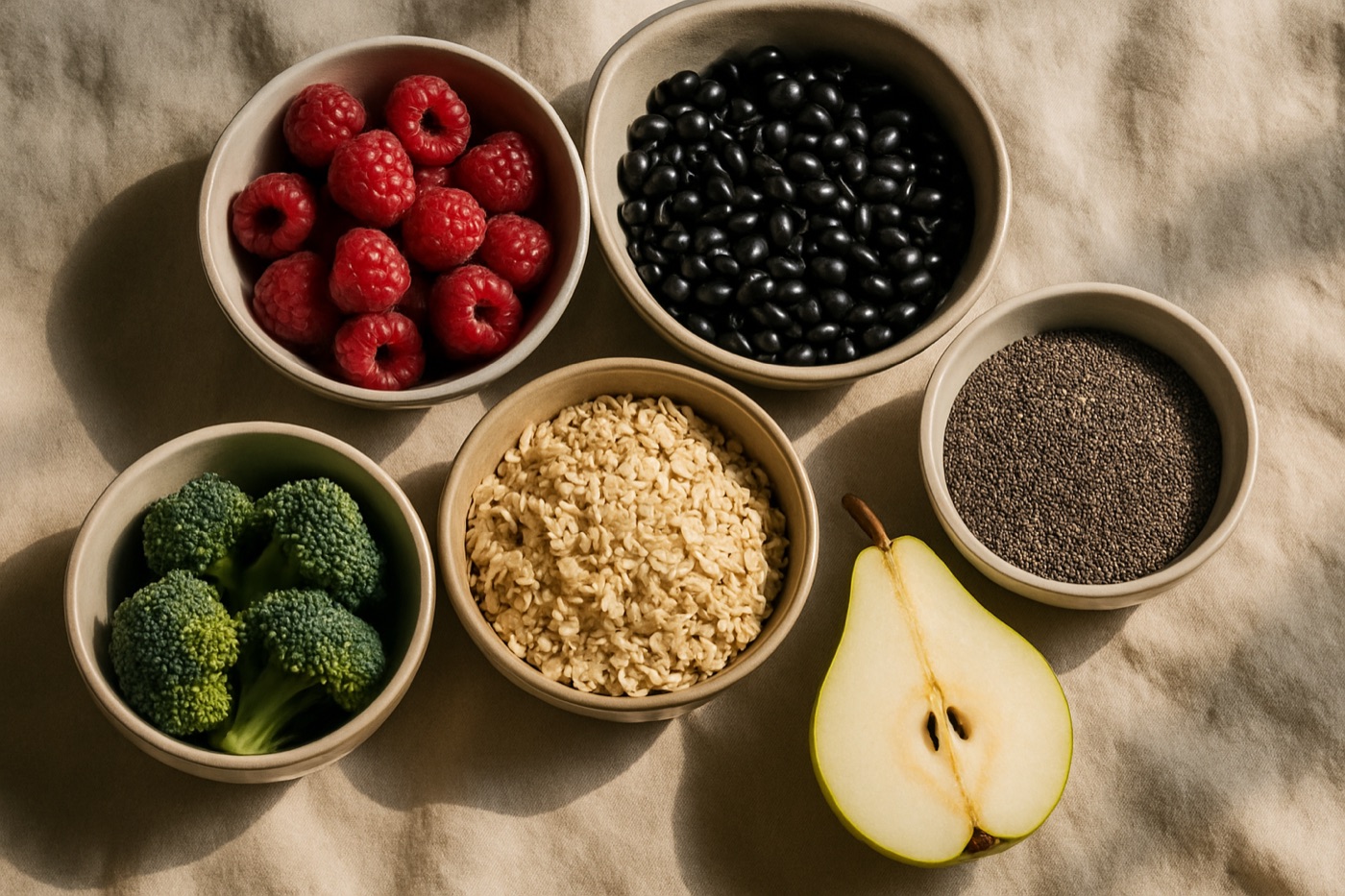
Fiber rarely gets attention in calorie tracking, which is a shame: it is one of the easiest ways to make a calorie target feel less like a diet. High-fiber foods tend to be filling for relatively few calories, and fiber supports digestion and long-term health.
How much you need
The U.S. Dietary Guidelines base fiber goals on calorie intake: about 14 grams for every 1,000 calories eaten. For most adults that works out to:
- Women: about 25 to 28 grams a day (lower after 50)
- Men: about 28 to 34 grams a day (lower after 50)
Surveys consistently show that most Americans fall well short, eating around half of their target.
If you are eating less than usual to lose weight, the per-1,000-calorie rule would give you a lower number. Most dietitians suggest keeping fiber near your normal-intake target anyway, because fullness matters most when calories are reduced.
Why it matters
- Fullness. Fiber adds bulk and slows digestion, which helps meals keep you satisfied.
- Digestion. It supports regular bowel movements and a healthy gut.
- Long-term health. Diets rich in fiber are associated with lower risk of heart disease, type 2 diabetes and some cancers. A large 2019 review commissioned for the World Health Organization (Reynolds and colleagues, The Lancet) found the biggest reductions in risk among people eating roughly 25 to 29 grams a day or more.
- Steadier blood sugar. Soluble fiber slows how quickly carbohydrate is absorbed, which can blunt sharp rises after meals.
Two kinds of fiber
- Soluble fiber (oats, beans, apples, citrus) dissolves in water into a gel and can help lower LDL cholesterol.
- Insoluble fiber (whole grains, vegetables, nuts) adds bulk and helps food move through the gut.
Most fiber-rich foods contain both, so you do not need to track them separately.
Approximate fiber in common foods
| Food | Serving | Fiber (approx.) |
|---|---|---|
| Lentils, cooked | 1 cup | 15–16 g |
| Black beans, cooked | 1 cup | 15 g |
| Chia seeds | 2 tablespoons | 10 g |
| Raspberries | 1 cup | 8 g |
| Pear, with skin | 1 medium | 5–6 g |
| Broccoli, cooked | 1 cup | 5 g |
| Rolled oats (dry) | ½ cup | 4 g |
| Whole-wheat bread | 1 slice | 2–3 g |
| Apple, with skin | 1 medium | 4 g |
| Almonds | 1 oz (about 23) | 3.5 g |
Fiber per calorie
For anyone counting calories, the most useful view is how much fiber a food gives you for its energy. Vegetables, berries and legumes lead easily:
| Food | Fiber per 100 calories (approx.) |
|---|---|
| Broccoli, cooked | 9 g |
| Raspberries | 12 g |
| Black beans, cooked | 7 g |
| Pear | 5 g |
| Rolled oats | 3 g |
| Whole-wheat bread | 2.5 g |
| Almonds | 2 g |
| White bread | under 1 g |
This is one reason a plate built around vegetables and beans feels so much bigger than one built around refined bread or pastries at the same calorie count. See our guide to calorie density for more on that idea.
What a 30-gram day looks like
| Meal | Food | Fiber (approx.) |
|---|---|---|
| Breakfast | ½ cup oats with 1 cup raspberries | 12 g |
| Lunch | Whole-wheat wrap with chicken and salad | 6 g |
| Snack | 1 pear | 5 g |
| Dinner | Chili with ½ cup kidney beans and vegetables | 8 g |
| Total | about 31 g |
None of this is unusual food; it is mostly a matter of choosing the whole-grain or bean-containing version of a meal you were going to eat anyway.
Easy ways to add fiber
- Swap refined grains for whole grains: oats, whole-wheat bread, brown rice.
- Add a can of beans to soups, salads and pasta sauces.
- Keep fruit with the skin on where you can.
- Top breakfast with berries or a spoon of chia or ground flaxseed.
- Fill half the plate with vegetables.
Increase fiber gradually over a few weeks and drink enough water, or your gut may protest.
Reading fiber on a label
On a U.S. Nutrition Facts label, dietary fiber is listed under total carbohydrate, with a percentage of the Daily Value based on 28 grams. As a rule of thumb, 5% DV or less per serving is low and 20% DV or more is high. Bread and cereal labelled “multigrain” or “made with whole grains” can still be low in fiber; the grams on the label are a better guide than the name on the front. Our guide to reading a nutrition label covers the rest of the panel.
Common mistakes
- Relying on juice and smoothies. Juice removes most of the fiber; blending keeps it, but smoothies are easy to over-pour in calories.
- Adding a lot at once. Going from 12 grams to 35 grams in a week usually means a week of bloating. Add a few grams every few days.
- Forgetting fluid. Fiber works best with enough water.
- Trusting “high-fiber” snacks blindly. Some bars get their fiber from added isolated fibers and still carry a lot of sugar. Check the whole label.
Tracking it
Most calorie trackers show fiber for each food. Add it as a daily target next to calories and protein; if you hit your fiber goal, you are usually eating enough fruit, vegetables, beans and whole grains as well.
The bottom line
Aim for roughly 25 to 34 grams a day depending on your age and sex, build it from beans, vegetables, fruit and whole grains rather than supplements, and raise it slowly. Of all the numbers you can track besides calories, fiber is one of the most likely to make the calories easier.
Related guides: Protein for weight loss · Calorie density · How many calories do I need?
Questions readers ask
How much fiber should I eat per day?
The U.S. Dietary Guidelines set fiber goals of about 14 grams per 1,000 calories. In practice that is around 25 to 28 grams a day for most adult women and 28 to 34 grams for most adult men, varying with age.
What foods are highest in fiber?
Beans and lentils (about 15 grams per cooked cup), raspberries (about 8 grams per cup), chia seeds (about 10 grams per 2 tablespoons), pears, broccoli, oats and whole grains are among the best everyday sources.
Does fiber count toward calories?
Partly. Fiber is a carbohydrate, but humans cannot digest it fully, so it provides fewer calories than sugar or starch, roughly 2 calories per gram for the fermentable kinds and close to none for insoluble fiber. Nutrition labels already account for this in the total.
Can you eat too much fiber?
Raising fiber quickly can cause bloating, gas and discomfort. Very high intakes, far above the recommended amounts, can also interfere with absorption of some minerals. Increase gradually over a few weeks and drink enough fluid.
Are fiber supplements as good as food?
Supplements such as psyllium can help with regularity and cholesterol, but they do not bring the vitamins, minerals and plant compounds that come with fiber-rich foods. Use them to top up, not to replace beans, fruit, vegetables and whole grains.
More: Guides · Reviews · Comparisons · The 2027 ranking