How to Read a Nutrition Facts Label
By Hannah Whitlock · Published October 22, 2026 · Updated October 22, 2026
A nutrition label tells you everything a calorie tracker needs, but only if you start with the serving size. Here is how to read the US Nutrition Facts panel in the order that matters.
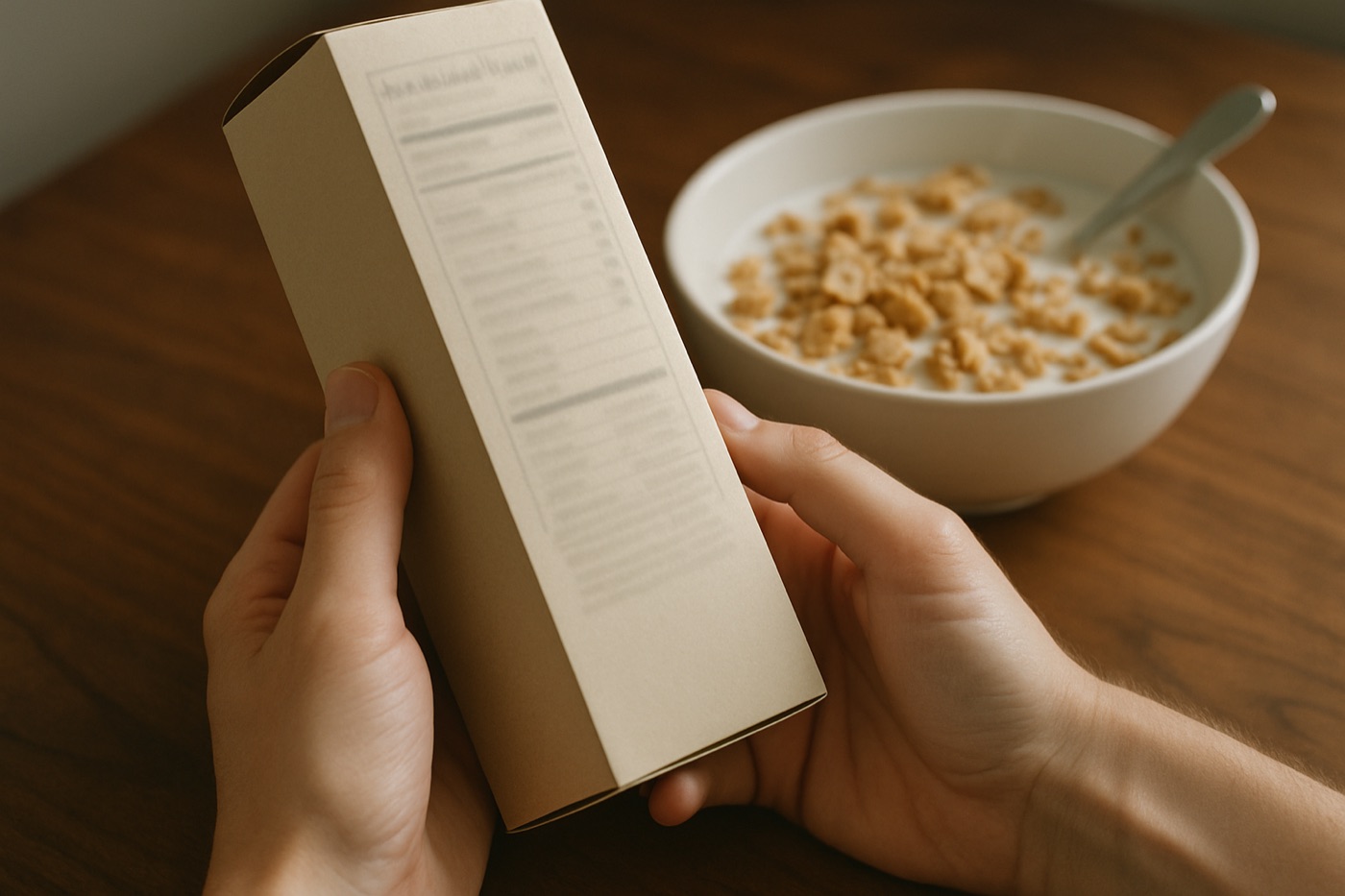
Scanning a barcode copies the label into your app, but it is still worth knowing how to read the label yourself: to check that the scan matched, to compare two products in the shop, or to log something your app does not know.
1. Serving size and servings per container
This is the line people skip and the one that matters most. Every number below it is for one serving. A bag of crisps might say 150 calories, but if the bag holds three servings and you eat it all, that is 450.
The US label was redesigned in 2016, and serving sizes were updated to reflect what people actually eat. Packages that are usually eaten in one sitting are now often labelled as a single serving.
2. Calories
Shown in large type since the redesign. This is the figure your tracker uses, multiplied by how many servings you ate.
3. The nutrients to limit and the nutrients to get
- Saturated fat, sodium and added sugars: most people eat more than recommended. The redesign added “Added Sugars” as its own line, separate from total sugars.
- Fiber, vitamin D, calcium, iron and potassium: most people get less than recommended.
4. Percent Daily Value (%DV)
%DV tells you how much of a day’s reference amount one serving provides, based on a 2,000-calorie diet. You do not need to add these up. Use them for quick comparisons: 5% DV or less is low; 20% DV or more is high.
5. The ingredient list
Ingredients are listed by weight, largest first. If sugar, or one of its many names, appears near the top, the product is a significant source of added sugar.
Labels and your tracker
When you scan a barcode, check that the product and serving size match what you are holding, then adjust the number of servings to what you ate. Trackers with large barcode databases will usually find the exact item. If a product is missing, you can create it from the label in a minute.
A worked example
Say a box of granola lists a serving as ⅔ cup (55 g) at 240 calories, with 4 g of fiber and 11 g of added sugars, and you pour a full cup into your bowl. A cup is one and a half servings, so your bowl is:
- 360 calories
- 6 g of fiber
- about 16 g of added sugars, roughly a third of the 50 g Daily Value
The label did not lie, but the bowl was half as large again as the serving it describes. This is the most common reason that people who “only had cereal” are surprised by their log. Pouring once into a measuring cup, then into the bowl you always use, solves it for good.
Comparing two products
%DV makes side-by-side comparisons quick, as long as the serving sizes are similar:
| Yogurt A | Yogurt B | |
|---|---|---|
| Serving | 150 g | 150 g |
| Calories | 90 | 160 |
| Protein | 15 g | 6 g |
| Added sugars | 0 g (0% DV) | 18 g (36% DV) |
Same pot size, very different foods. Yogurt A is the better fit for most calorie targets: fewer calories, more protein and no added sugar. If two serving sizes differ, compare per 100 g instead; you can calculate it by dividing each figure by the serving weight and multiplying by 100.
Dual-column labels
Some packages that could be eaten in one sitting or several, such as a pint of ice cream or a large bag of crisps, now show two columns: one per serving and one for the whole package. If you are likely to finish it, log the package column.
Words on the front of the pack
Front-of-pack claims are not the label. A few to read carefully:
- “Low fat” says nothing about sugar or calories. Some low-fat products have similar calories to the regular version.
- “Made with whole grains” can mean a small amount. Check the fiber line.
- “No added sugar” still allows naturally sugary ingredients such as fruit juice concentrate.
- “Net carbs” is not defined by US regulators; it is a marketing figure, usually total carbohydrate minus fiber and sugar alcohols.
Rounding rules
US labels round small numbers. Calories under 5 can be shown as 0, between 5 and 50 are rounded to the nearest 5, and above 50 to the nearest 10. Fat below 0.5 g per serving can be listed as 0 g. That is why some sprays, sweeteners and dressings appear to be “zero”; in large amounts, they are not.
A note on accuracy
US rules allow some tolerance between the stated and actual nutrient content, so labels are close rather than exact. They are still the best information you have for packaged food, and far better than a guess.
For calories, sugars, fat and sodium, the FDA generally treats a product as compliant if its actual content is no more than 20% above the declared value. Labels are therefore a reliable guide, but a slightly optimistic one for the nutrients you are trying to limit.
Outside the United States
UK and EU labels look different: they list values per 100 g or 100 ml (and often per portion), show energy in both kilojoules and kilocalories, and in the UK many packs carry a front-of-pack “traffic light” panel showing whether fat, saturated fat, sugars and salt are low, medium or high. For calorie tracking, always use the kcal figure and check whether you are reading the per-100 g or per-portion column.
The bottom line
Read the serving size first, then calories, then the lines that matter for your goal. Compare products by %DV or per 100 g, and treat front-of-pack claims as advertising until the label confirms them.
Related guides: Log a home-cooked recipe · How much fiber a day · Calorie tracking glossary
Questions readers ask
What should I look at first on a nutrition label?
The serving size and the number of servings per container. Every other number on the label refers to one serving, so if you eat two servings, double everything.
What does % Daily Value mean?
It shows how much of a day's recommended amount one serving provides, based on a 2,000-calorie diet. As a rule of thumb, 5% or less is low and 20% or more is high.
Why does cooking spray say zero calories?
US rounding rules let a product list 0 calories when a serving has fewer than 5. Cooking spray servings are tiny (often a quarter-second spray), so each counts as zero, but a long spray in a pan can add 20 to 50 calories or more.
Are nutrition labels the same in the UK and Europe?
No. UK and EU labels must show energy and nutrients per 100 g or 100 ml, often with a per-portion column too, and show energy in both kilojoules (kJ) and kilocalories (kcal). Use the kcal figure for a calorie tracker; 1 kcal is about 4.2 kJ.
More: Guides · Reviews · Comparisons · The 2027 ranking