How to Log a Home-Cooked Recipe Accurately
By Theo Marchetti · Published October 22, 2026 · Updated October 22, 2026
The most accurate way to log a home-cooked dish is to add up the raw ingredients, weigh the finished pot, and log your portion by weight. It takes five minutes the first time and seconds after that.
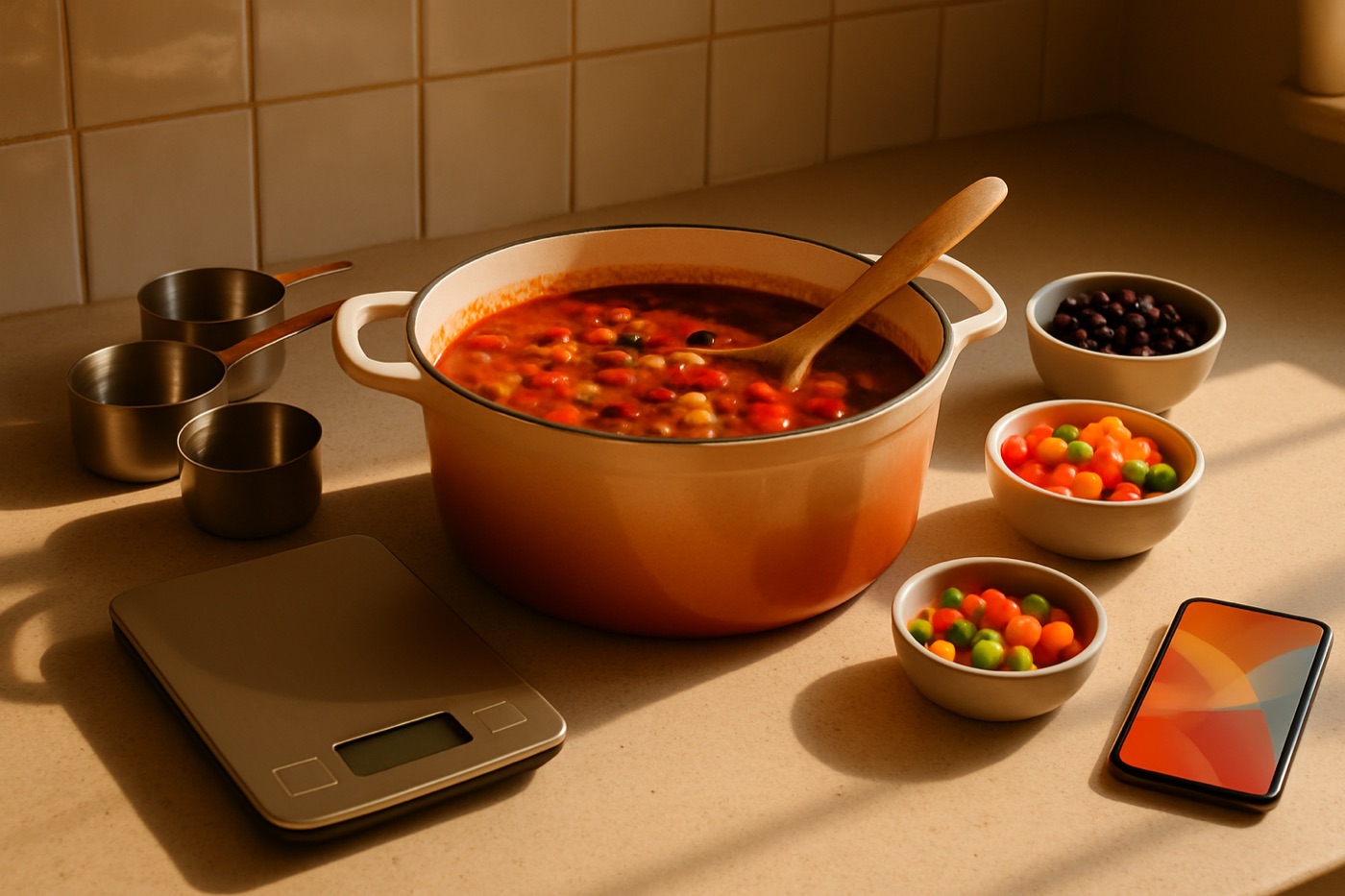
Home cooking is usually healthier than eating out, but it is often logged worse. People type “chili” into an app, accept the first result and move on, even though their chili might have twice the beans and half the oil of the database version. Logging the actual recipe fixes that.
The method in five steps
- List every ingredient, including oil, butter, sugar and sauces.
- Weigh or measure each one raw and enter it in your app’s recipe builder (or a list).
- Cook as usual.
- Weigh the finished dish in grams. Weigh the empty pot first so you can subtract it.
- Log your portion by weight. If the whole pot is 2,400 calories and weighs 2,000 g, it is 1.2 calories per gram; a 350 g bowl is 420 calories.
Why weigh the finished dish?
Counting “servings” works if you divide the pot into exactly equal parts. In real life the first bowl is bigger than the last. Weighing your portion against the total weight removes the guesswork, and it automatically accounts for water that boiled away.
Raw versus cooked
Cooking changes weight, not calories (apart from fat that drips away). Rice and pasta absorb water and get heavier; meat loses water and gets lighter. That is why the recipe should be built from raw weights, and why database entries labelled “cooked” and “raw” have very different calories per 100 g. Always check which one you are picking.
The ingredients people forget
- Cooking oil (about 120 calories per tablespoon)
- Butter for the pan or the vegetables
- Sugar or honey in sauces and dressings
- Cheese on top
- Stock cubes and coconut milk
A worked example: vegetable chili
Here is the method applied to one pot of chili that makes about six bowls. Values are approximate:
| Ingredient (raw) | Amount | Calories |
|---|---|---|
| Olive oil | 2 tablespoons | 240 |
| Onions | 2 medium (300 g) | 120 |
| Peppers | 2 (300 g) | 90 |
| Canned chopped tomatoes | 2 cans (800 g) | 160 |
| Kidney beans, drained | 2 cans (480 g) | 530 |
| Sweetcorn | 1 can (200 g drained) | 160 |
| Spices, garlic, stock | — | 40 |
| Total | 1,340 |
The finished pot weighs 2,200 g after simmering, so the chili is about 0.61 calories per gram. A 400 g bowl is about 245 calories; add 30 g of grated cheese (about 120) and a tablespoon of sour cream (about 30) and the bowl comes to roughly 395.
Notice what drives the total: the oil and the beans. If you used one tablespoon of oil instead of two, every bowl would be about 20 calories lighter.
Batch cooking and leftovers
If you cook on Sunday for several days, weigh the pot once, note the calories per gram in your app’s recipe, and portion it into containers. Write the weight on each lid. During the week, logging lunch becomes a single entry with a number you already know.
Baking
Baked goods work the same way, but count by pieces rather than weight if they are cut evenly. A tray of 16 brownies is the total of the ingredients divided by 16. Remember that butter, sugar, chocolate and nuts make baking dense; one slice of homemade cake can be 350 to 450 calories.
Common mistakes
- Logging cooked weights against raw entries, or the reverse. 100 g of cooked rice is about 130 calories; 100 g of raw rice is about 360.
- Forgetting the oil in the pan.
- Using the “serves 4” on a recipe card when you actually served three generous bowls.
- Choosing a generic entry for something you cook every week. Save it once and you never have to guess again.
Save it once
Most trackers let you save a recipe so next time you only log a portion. Build your five or six regular dinners once, and home cooking becomes the easiest thing in your diary to log. In apps with photo logging you can still photograph the bowl and then swap the estimate for your saved recipe.
Logging other people’s cooking
When someone else cooks, you will not know the exact recipe. Log the closest dish, judge the portion against your hand or plate, and add a tablespoon of oil for anything fried, roasted or sautéed. Our guide to tracking without a food scale has portion shortcuts.
The bottom line
Raw ingredients in, finished dish weighed, portion logged by weight. It is the single most accurate habit in home calorie tracking, and you only do the hard part once per recipe.
Related guides: Read a nutrition label · Track calories without a food scale · Calorie density
Questions readers ask
How do I calculate calories in a homemade meal?
Add up the calories of every ingredient, weighed raw. Weigh the cooked dish in grams. Divide total calories by total grams to get calories per gram, then multiply by the weight of your portion.
Should I weigh food raw or cooked?
For recipes, weigh ingredients raw and log them as raw entries, because cooking changes weight through water loss or gain while the calories stay roughly the same. Then weigh the finished dish to split it into portions.
How do I log a recipe if I did not weigh the finished dish?
Divide the total calories by the number of portions you served, and try to serve equal portions. It is less precise than weighing, but much better than picking a generic database entry.
How do I count calories in soup or stew?
The same way as any recipe. Add up the raw ingredients, including any oil and cream, weigh the finished pot, and log your bowl by weight. Soups lose water as they simmer, so weighing at the end matters more than for most dishes.
More: Guides · Reviews · Comparisons · The 2027 ranking